Most of (an actually good) pre-university mathematics education consists of applying methods for a given problem, or perhaps the ability to combine those steps in problem-solving. Though plausible arguments may be given to convince learners of their validity, a rigorous, logical approach development of a subject of pre-university mathematics is seldom given. While I don’t think learning rigorous proofs are strictly necessary for a good mathematics education (though I would strongly prefer such an approach), it does lead to confusion around some things, such as to whether proofs without words are valid proofs, why the epsilon-delta definition of a limit exists when we can intuitively find limits anyway. At its worst, it can lead to pointless arguments such as whether 0.9999... = 1 (It is 1). So, what is actually going on?
Ideally, we would like a proof for every statement to believe in math that follows from the rules of logic. However, this would mean that for each statement we give, we need to prove it using other statements we believe to be true. Of course, these statements also need proof, so we need to use even other statements to prove them. Hence, either we have an infinitely long chain of proofs and statements, which is impossible (we only have a finite amount of words in English); or the chain has to circle back to one of previous statements, rendering the logic chain useless anyway. Thus, we must have a set of unproven statements which serve as our starting point.
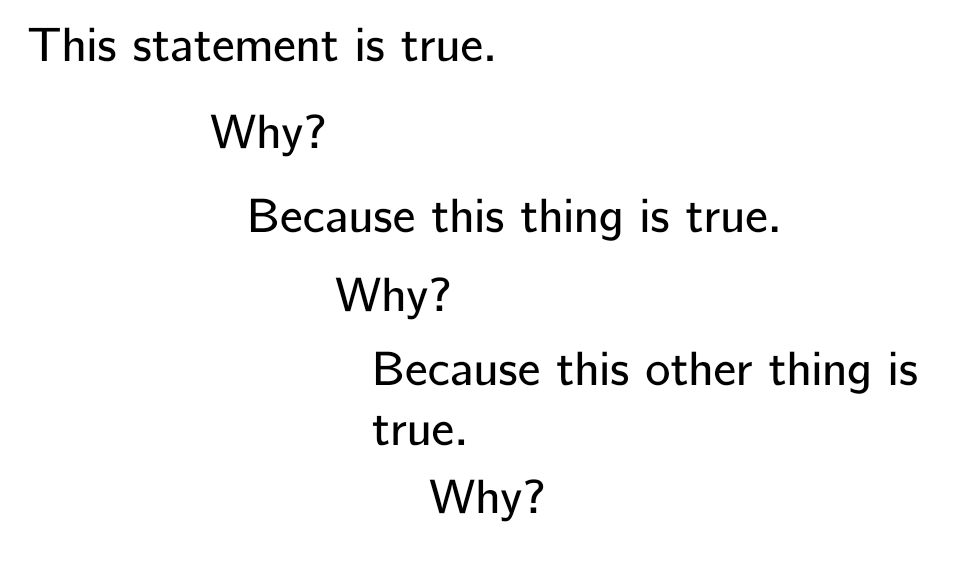
We call such statements axioms or postulates. We call any statement that can be shown true from the axioms a theorem. We are also allowed to prove new theorems using statements proved from the axioms, since their truth has been already established. In a rigorous proof, one must only follow the rules of mathematical logic and only use the previously stated axioms or theorems. The rules are not the focus of this article, but you can find an overview of them here. Any argument that utilizes things other than these, such as fallacies, is logically invalid and is not proof. Strictly speaking, any argument that omits minor logical details is also not proof. However, in actual written proofs, there are many logical steps that are obvious or trivial which are omitted, since they make the proof harder to read or they detract from the main idea. It is instead assumed that the reader can fill up the missing details if they doubt a particular step or so.
Similarly, we must be precise about the meaning of the terms we use through definitions. For similar reasons aforementioned, we cannot define all terms we use precisely. Thus we have to leave a set of terms without definitions, called undefined terms or primitives. All of these things form what is called an axiomatic system.
Every statement in a particular branch of mathematics can be derived from a set of axioms. Technically, one can choose any set of statements to comprise an axiomatic system, as long as contradictions do not arise from them. Usually though, the choice of axioms depends on whether they are interesting, their power (that is, an axiomatic system’s ability to prove a lot of theorems from a meager set of axioms), or if it reflects statements that are true in the real world.
To illustrate, we use give examples:
A three-point geometry is an axiomatic system composed of these four axioms:
The undefined terms of our system are: point, line, on. We can define meet as follows:
Definition. Two lines meet iff there exists a point such that the point lies on both of those lines.
We must be careful at our assumptions. Nothing in three-point geometry says that lines must be straight, nor that they are made up of points (In fact, there are only three of them!) Unlike ordinary geometry, we have no notion of congruence, similarity or even size since we have not defined those terms. Nevertheless, we can prove a small amount of theorems in this meager set of axioms. For one, we can stengthen the fourth axiom through proof by contradiction as follows:
Two distinct lines meet on exactly one point.
Let $\ell$ and $\ell_2$ be distinct lines. By Ax. 4, they meet on a point. We call that point $P$. Now suppose they meet on another distinct point, which we call $Q$. However, by definition of meet, point $P$ is on the lines $\ell$ and $\ell_2$. Similarly, $Q$ is on $\ell$ and $\ell_2$. This contradicts Axiom 4. Therefore, two lines meet on exactly one point.
How many lines does this geometry have? This can be settled by the next theorem:
There are only exactly three lines.
By Ax. 1, there are exactly three points, which we call $P$, $Q$ and $R$. By Ax. 2, lines $\ell_1 : \overleftrightarrow{PQ}$, $\ell_2 : \overleftrightarrow{PR}$ and $\ell_3 : \overleftrightarrow{QR}$ exist. Thus there are at least three lines. Suppose there is a fourth line we call $\ell_4$. By Ax. 4, given line $\ell_4$ and $\ell_2$, they meet on either point $P$ or $R$ (Why?). (The choice of $\ell_2$ is arbitrary; any of the other existing lines could be chosen as well). Without loss of generality, say they meet on $P$ (the proof for $R$ is similar). Then lines $\ell_4$ and $\ell_1$ must meet at $Q$ by Ax. 4 (Why?), but this contradicts Ax. 2. Hence $\ell_4$ cannot exist; that is, there are exactly three lines.
We can construct representations of our three-point geometry as follows:
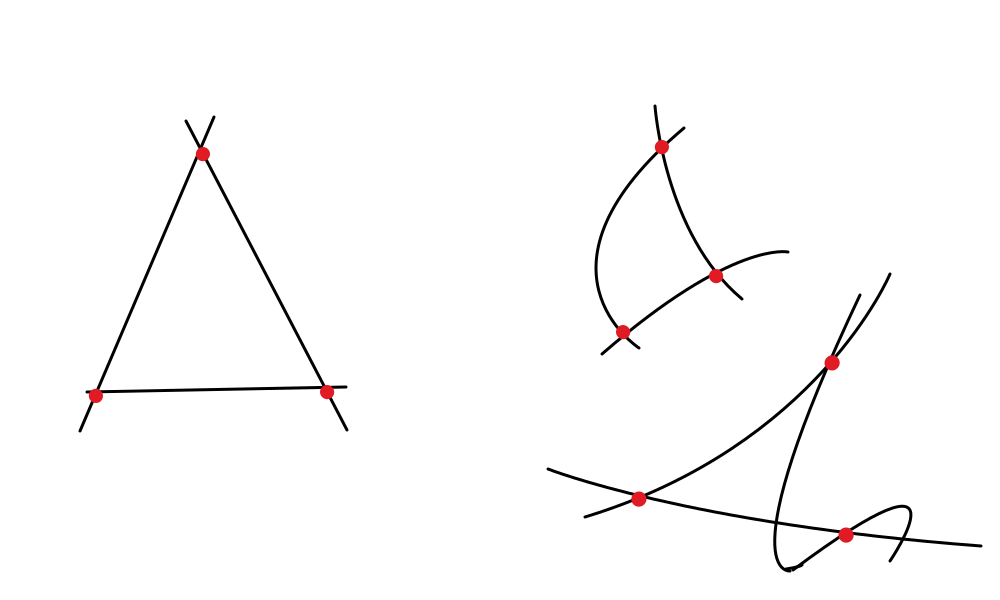
Here, black streaks represent lines and the red dots represent points. Our representations must follow the rules of our axiomatic system; that is, there are only two points, two points must meet on one line, etc. Nothing in our system says that lines have to be straight, so they can be curvy as we want it to be. In the figure on the lower-right, one of the lines appear to “meet” on two points, seemingly violating Ax. 4. However, only one of the “intersection” areas have a red dot on them, so they really only intersect at one.
Since we haven’t assigned definitions to the words point, line, on; we are actually free to assign any meaning we want to them. We could interpret point as coffee bean, line as plate:
and since we only followed the rules of logic, the theorems we have proven earlier still hold true. In fact, we can make a representation of this interpretation as follows. We leave it up to you to verify that this satisfies our axiomatic system.

We call representations that follow all the rules of an axiomatic system a model of it. Since all the axioms hold true in our models, the theorems we have proven must as well (There are exactly three lines in all of our models, for example). However, what is true of our models is not necessarily true or provable in an axiomatic system. Furthermore, what is true in one model is not necessarily true of the other models. Though our models are very helpful in suggesting things that are true, any argument that is based on reasoning about diagrams is not proof, and is not rigorous. An example of fallacious diagramatic reasoning is the classic infinite chocolate bar trick.
Do the axioms have to be necessarily true all the time for an axiomatic system to function? No! Obviously, our world is composed of more than three lines and points, let alone three coffee beans and three plates. Our logic only says that if this assumption X is true, then this thing Y must be true. Not that assumption X is always true! However, if we do encounter systems in which our axioms do hold, then all of its theorems must hold in the system as well, such as in our line and point models.
We revisit a topic that is more within school mathematics. The algebra we learn in school can actually be axiomatized. We take a set of objects called real numbers as our starting point undefined. We equip it with two binary operations addition $+$ and multiplication $\cdot$, which we also leave undefined (it is possible to define all of them, but we will not for our purposes). Equality $=$ itself is also an undefined term, and we borrow the axioms of equality from logic. The axioms are thus follows:
Let $\mathbb{R}$ be the set of real numbers equipped with addition and multiplication. We assume the following are true for any real numbers $a$, $b$ and $c$:
Here we introduce an undefined relation called greater than $<$, which satisfies
Lastly, there is also the completeness axiom but we won’t make use of this axiom here. Again, for a rigorous proof, we must only proceed from the axioms and previously proved theorems through logic. We are not allowed to assume even stuff that seems obvious to us without such proof. Now we are ready to prove some basic facts we already know about algebra:
Firstly, we know that 1 and 0 are numbers such that adding or multiplying any number by it, respectively, outputs the same number. But are there any other numbers with the same property?
(Uniqueness of the Identity) Let $a$ be a real number. 0 is the only real number such that $a + 0 = a$ for all $a$. Similarly, 1 is the only real number such that $a \cdot 1 = a$ for all $a$.
Suppose there is another identity $0'$ such that $a + 0' = a$ for all $a$. We make use of the commutative property: $$ 0 = 0 + 0' = 0' + 0 = 0' $$ Turns out, 0 and 0' are the same number after all; thus, it is unique. It can be shown similarly that 1 is also unique.
Similarly, it can be shown that the inverse of a real number $a$, $^-a$, is unique:
(Uniqueness of Inverses) Let $a$ be a real number. Then there is only one real number, $^-a$ such that $^-a+a= 0$.
Suppose $a$ has another inverse $^-a'$. Then: \begin{align} {}^{-}a&={}^{-}a+0 & \text{Existence of the Identity} \\ &={}^{-}a + (a + {}^{-}a') & \text{Existence of Inverses} \\ &=({}^{-}a + a) + {}^{-}a' & \text{Associativity} \\ &= 0 + {}^{-}a' & \text{Definition of an Inverse} \\ &= {}^{-}a' & \text{Existence of Identity}\\ \end{align} This shows that $^-a = {}^{-}a'$; that is, the inverses are unique. It can be shown similarly that multiplicative inverses are also unique.
This allows us to prove the following theorem:
(Cancellation Law of Addition) For any two real numbers $a$ and $b$, if $a+c=b+c$, then $a=b$.
\begin{align} a+c&=b+c & \\ (a+c)+{}^{-}c &= (b+c) + {}^{-}c & \text{Existence of Inverses and Closure} \\ a+(c+{}^{-}c) &= b+ (c + {}^{-}c) & \text{Associativity} \\ a+0 &= b+0 & \text{Definition of an Inverse} \\ a &= b & \text{Existence of Identity}\\ \end{align}
Since inverses are unique, we can define the familiar binary operation of subtraction:
Definition. Let $a$ and $b$ be two real numbers. The difference of $a$ and $b$, denoted as $a - b$, is defined as: $$a- b = a + {}^-b.$$ The binary operation $-$ acting on $a$ and $b$ is called subtraction.
We remark that $0-a$ is typically written as $-a$. Since the inverse of $a$ is $^-a$ and by definition, $0-a = 0 + {}^-a = {}^-a$; we can write $^-a$ as $-a$ as it is usually done. We still have a lot of work to do. For instance, we haven not proven that for any real numbers $a$, $b$ and $c$:
From these we can prove most of the theorems in elementary algebra we know and love, such as the quadratic formula. As you can see, every property of real numbers we have taken for granted take a lot of effort to prove rigorously. Of course, these properties are obvious from what we know about numbers in real life. However, from a rigorous viewpoint, the truth of these statements only depend on logic, and not on their correspondence to reality. Real-life quantities only serve as a model for our axiomatic system; though our axiomatic system is specifically constructed to make its theorems consistent to what we observe when dealing with quantities.
You might be wondering; what’s all the fuss about proving stuff we already know to be true? And indeed, mathematicians, until relatively recently, did not usually worry too much about the logical foundations of their field; that question was usually left to philosophers. Newton and Leibniz were able to develop calculus using intuitive and geometric arguments. Even ancient civilizations, such as Egypt, were able to discover a lot of facts through trial and error, not through proof.
One obvious reason is that our common sense and reasoning might be misleading. The “proof” that all triangles are isosceles in Euclidean geometry, for example, relies on a very subtle flaw to deceive the reader. The Italian school of algebraic geometry which once was able to make progress in algebraic geometry, eventually “proved” a lot of results that turned out to be false due to declining standards of rigor. Furthermore, one intuitive argument that may make sense to someone may not to somebody else.
Another reason is that studying the abstract, logical structure of a subject can reveal a deeper, underlying structure of a broader, more general theory. We can take the axiomatic system of the real numbers. Suppose we only assume the field axioms as our starting point. Any system that follows the field axioms is called a field. Turns out, not only the real numbers form a field. Take the system of complex numbers; that is, numbers of the form $a +bi$. From experience dealing with them, we know that it is commutative, associative, distributive, etc. under both addition and multiplication. The identity elements are both 0 and 1, and the inverse of any complex number $a +bi$ is $-a - bi$. Since we have made no reference to actual properties of real numbers, the theorems we have proved are true for all complex numbers as well! That is, identities and inverses are unique, the cancellation law holds, etc. The set of quaternions also form a field. Fields also don’t have to contain numbers. Consider the set $\{0, 1, \alpha, \alpha + 1\}$, in which “addition” and “multiplication” are defined by the following tables:
| + | 0 | 1 | α | α + 1 |
|---|---|---|---|---|
| 0 | 0 | 1 | α | α + 1 |
| 1 | 1 | 0 | α + 1 | α |
| α | α | α + 1 | 0 | 1 |
| α + 1 | α + 1 | α | 1 | 0 |
| × | 0 | 1 | α | α + 1 |
|---|---|---|---|---|
| 0 | 0 | 0 | 0 | 0 |
| 1 | 0 | 1 | α | α + 1 |
| α | 0 | α | α + 1 | 1 |
| α + 1 | 0 | α + 1 | 1 | α |
[unfinished] If we used the intuitive properties of numbers that we already know to “prove” them, we’ll then have to reprove them when we encounter other number systems that follow different rules.
[The writing of this article has taken too much of my free time, i will continue this tomorrow. In the meantime you can take a look at this Back

