Most often, students learn limits rigorously using the epsilon-delta definition. However, quite a few textbooks use or promote an alternative approach. One such approach involves sequences. For me, this approach is closer to how limits are usually introduced intuitively, though I am not necessarily endorsing this approach---I just want to show how things could be done differently.
First we define what we mean by a sequence.
Definition. A sequence is a function whose domain is the set of natural numbers; that is, $f : \mathbb{N} \rightarrow A$ for some subset $A \subseteq \mathbb{R}$. The elements of $A$ are called the terms of a sequence.
Thus, we do not consider finite sequences with only a finite number of terms.
For example, consider the list 1, 1.01, 1.001, 1.0001, ... and so on. If we define the function $f$ so that it assigns the $n$th natural number to the one with $n - 1$ 0's in the list ($f(1) = 1$, $f(2) = 1.01$, ... and so on), then $f$ is a sequence. Typically we use the notation $a_n$ instead of $f(n)$ for the terms of the sequence, and $\{ a_n \}$ for the sequence itself.
Intuitively, we can "define" the limit of a sequence to be the value that it approaches as $n$ approaches infinity or $n \rightarrow \infty$. For some sequences, the limit is obvious. For instance, it is clear that the sequence $\{ \frac{1}{2^n} \}$ or $\{ 1, \frac{1}{2}, \frac{1}{4}, \frac{1}{8}, ... \}$ approaches 0 as $n$ increases without bound. Similarly, it can be seen using a table of values that as $n\rightarrow\infty$,
$$\left\{\frac{4n^2 - 5n + 1}{3n^2 + 6} \right\} \rightarrow \frac{4}{3}.$$
For other sequences though, the limit is not as obvious. Take the sequence
$$1, 0, 1, 0, 1, 0,...$$
Does this sequence eventually approach 1, 0 or 1/2 as a compromise?
A natural way of answering this is through error bounds. To help, we introduce a new definition:
Definition. A statement $C$ holds for sufficiently large $n$ or for large $n$ iff there exists a positive integer $N$ such that for every natural number $n > N$, $C$ is true.
Consider the statement $8n^2 + 10n + 5 \leq n^3 - 1$ For small $n$, like $n = 2$, it is false ($57 > 7$). However, for every $n$ larger than 10, the expression on the right "overtakes" the one on the left; thus the inequality holds true. We can therefore pick $N = 10$ so that the statement above is true. Therefore, $C$ holds for large $n$ ($n > 10$).
Definition. A sequence converges to $L$ iff there exists a real number $L$ such that for each positive $\epsilon > 0$, there is a corresponding $N$ such that for large $n >N$,
$$ |a_n - L | < \epsilon$$
holds. We write this as
$$\lim a_n = L.$$
We also say that the limit is $L$.
This inequality says that the distance between each $a_n$ and $L$ is no greater than $\epsilon$ (Recall that the distance between two real numbers $b$ and $a$ is given by $|b - a|$).
We can illustrate this definition by as follows. Take the sequence
$$a_n = \left\{ \frac{1}{2^n} \right\}$$
again, which we intuitively guessed its limit to be 0. Suppose that $\epsilon = 0.25$. That is, the distance between $a_n$ and $0$ must be less than 0.25. Below is the graph of the sequence in blue:
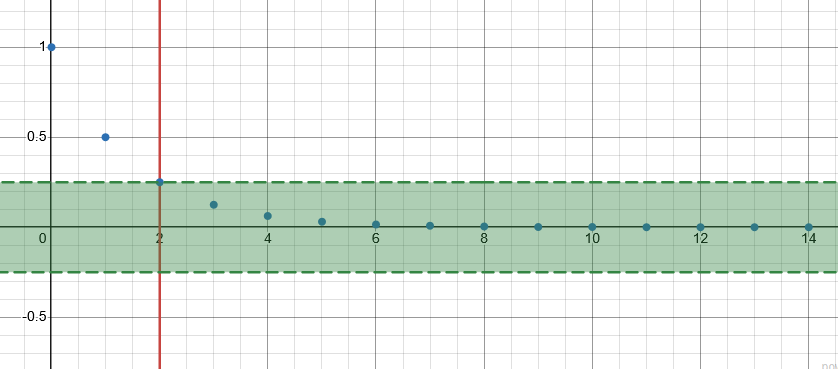
The green area represents all points [not just $(n, a_n)$] that satisfy our inequality; that is, all points inside the graph of $|y - 0| < 0.25$. Notice that this is so for all sequence points beyond the red line. In other words, all values of $a_n$ satisfy $|a_n - 0| < 0.25$ for all $n > N$, $N = 2$. If we make $\epsilon$ smaller, say $\epsilon = 0.01$, we suddenly find that $N$ is too small to make all the blue dots to fit inside the green area:
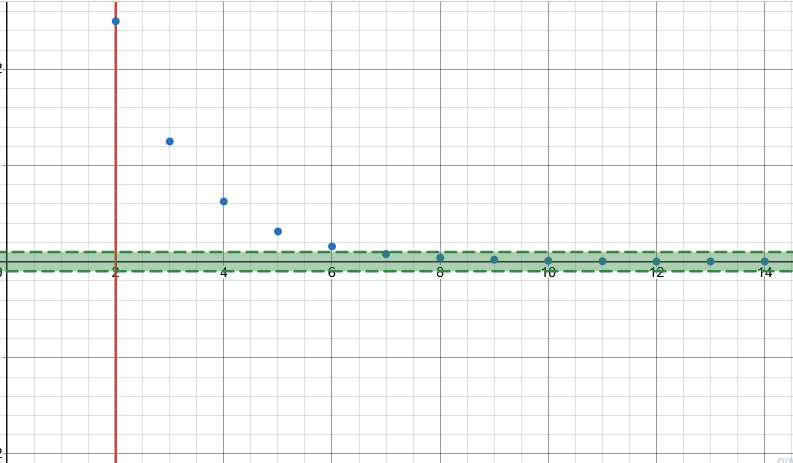
Therefore, if the limit is indeed 0, we must find a sufficiently larger $N$ that makes the inequality true. Picking $N = 6$ does the trick:
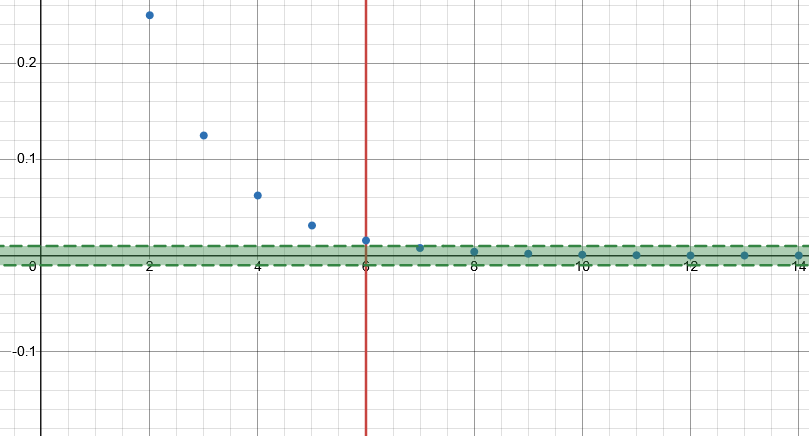
Now all the blue dots are in the green area; that is, for all $n > 6$, $|a_n - 0| < 0.01$. For illustration, $|a_7 - 0| = 0.0078125 < 0.01$.
However, this illustration does not prove that the limit is actually 0. We show the rigorous proof below:
Let $\epsilon > 0$. By the Archimedean property, there exists $N \in \mathbb{N}$ such that $1 < N\epsilon$, or $\frac{1}{N} < \epsilon$. For all $n \in \mathbb{N}$, if $n > N$, $\frac{1}{n} < \frac{1}{N}$. Furthermore, $n \leq 2^n$ for $n \geq 1$, thus $\frac{1}{n} \leq \frac{1}{2^n}$ (this can be shown by either induction or Bernouili's inequality). Therefore,
$$\left|\frac{1}{2^n} - 0\right| \leq \frac{1}{2^n} < \frac{1}{n} < \frac{1}{N} < \epsilon$$
(Note that we can get rid of the absolute value sign since we're dealing with positive real numbers $n$ anyway). This completes the proof.
The following theorems will be useful in proving limits of sequences, which we will not prove here:
(Triangle Inequality) For any real numbers $a$ and $b$,
$$ |a + b| \leq |a| + |b| $$
For any real numbers $a$ and $b$,
$$ |a - b| \geq |a| - |b| $$
We are now able to prove this obvious theorem for limit addition:
Let $\{ a_n \}$ and $\{ b_n \}$ be sequences. If $\lim a_n = L$ and $\lim b_n = M$, then $\lim (a_n + b_n) =L + M$.
Let $\epsilon > 0$. It follows that $\epsilon / 2$ is also an arbitrary positive number. Since $\{ a_n \}$ and $\{ b_n \}$ are convergent, there exist $N_1$ and $N_2$ such that for all $n > N_1$
$$ |a_n - L | < \epsilon /2$$
and for all $n > N_2$,
$$ |b_n - M | < \epsilon / 2$$
respectively.
We choose $N = \max \{N_1, N_2 \}$ to ensure that both two inequalities above hold. By the triangle inequality,
\begin{align*} | (a_n - H_1) + (a_n - H_2) | &= |(a_n + b_n) - (H_1 + H_2)| \\ &\leq |a_n - H_1| + |b_n - H_2| \\ &< \epsilon / 2 + \epsilon / 2 \\ &= \epsilon. \end{align*}
The proof for the multiplication law is more complicated though. I'll leave the proof for the other laws for part 2.
We can now define the limit of a function in terms of a sequence:
Definition. Let $f$ be a real-valued function with real domain $D$. Let $a$ be a real number with a sequence $\{ a_n \}$ converging to it that satisfies $a_n \in D - \{ a \}$ for all $n$ (In other words, $a$ is a limit point of $D$).
Then the limit of the function $f$ is a real number $L$ iff all sequences $\{x_n\}$ converging to $a$ with each $x_n \in D - \{a\}$ satisfy
$$\lim f( x_n ) = L.$$
We denote this as
$$\lim_{x \rightarrow a} f(x) = L.$$
We remark a few things.
We added the restriction that all sequences must satisfy $a \in D - \{ x_n \}$ since we want to study the behavior of $x$ near $a$, not at $a$. Supppose we did not. We define a function $g$ such that
\begin{equation}g(x) = \begin{cases} \label{deff} 0 & \text{if } x \neq 1 \\ 3 & \text{if } x = 1 \end{cases}\end{equation}
We intuitively guess that $\lim_{x \rightarrow 1} g(x)$ should be 0 ($L = 0$). For that to be true, all sequences $x_n$ in the domain of $g$ that converge to 1 must satisfy $\lim g( x_n ) = 0$ as well. We are then allowed to use the constant sequence $\{ 1 \}$ which converges to $1$. But by our modified definition, $\lim g(1) = 3 \neq 0$, which doesn't make sense.
Similarly, we require that $a$ be a limit point of $D$, since we could also define a function something like $f:[0,2] \rightarrow 1$ and $f(1) = 5$. I could then say that $\lim_{x \rightarrow a} f(x) = 6.67 \times 10^{-11}.$ which is absurd, but vacuously true.
There's also an interesting approach by Marsden that does away with limits altogether; but that’s a topic for another post.
I'll try to post part 2 by next week.

